
We are glad to tell in words as well as deeds the faith that is in us. We seek fellowship with others of our own faith and with all people, realizing the oneness of humanity under God. Our witness is characterized by humility and a willingness to learn from others so that differences can be transcended. In discussion, we must not allow the strength of our convictions to betray us into making misleading or contentious statements. The experiences of others, especially those in circumstances different from our own, help us to discover what is true for us and may help us sense real kinship. We are constantly reminded that Truth is greater than the knowledge any of us has of it. God did not put all the fruit on one branch.
How do our lives testify to our convictions as Friends?
What are we doing to share our faith?
How do we practice listening to the Truth which may be revealed by others?
What ways do we find to cooperate with persons and groups with whom we share beliefs and concerns?
Do we reach out with love and respect to those with whom we disagree?
What are we doing to make the larger community aware of our Friends Meeting?
People everywhere are children of God and members of one family. We value the worth of each person. We cannot be easy in our own lives when others suffer indignity, injustice, or want. In the Spirit of Christ, we are ready to put ourselves at one another’s side and share each other’s burdens. As we are true to the Divine within ourselves, we respond to the Divine in others.
Do we speak to and answer “that of God” in everyone?
In all our relations with others, are we sensitive to issues of equality, autonomy, and power? How do we challenge destructive patterns in these relationships when they arise?
How do we encourage ourselves and others to consider people as individuals, rather than as stereotypes?
What are we doing about the injustices which are part of our social and economic life?
How do we help those who suffer from discrimination?
Do we avoid being drawn into violent reactions against those who are destructive of human dignity?
Do we reach out to the violator as well as the violated with courage and love?
Do we search diligently for ways of assuring the right of every individual to be loved, cared for, and educated appropriately, to obtain useful employment; and to live in dignity?
The heart of the life of the Religious Society of Friends is the Meeting for Worship. It calls for us to offer ourselves, body, mind, and soul for the doing of God’s will.
Worship is the adoring response of the heart and mind to the influence of the Spirit of God. It stands neither in forms nor in the formal disuse of forms; it may be with or without words, but it must be in spirit and in truth (John 4:24). We recognize the value of silence, not as an end, but as a means toward the attainment of the end, which is communication with God, and fellowship with one another.
In all our Meetings for Worship, we gather in a spirit of prayerful obedience to God, with a willingness to give as well as to receive. In speech or in silence, each person contributes to the Meeting. Worshiping God together, we strengthen one another, and our bodies and minds are refreshed in the Life of the Spirit. Our daily lives are linked with the Meeting for Worship, the Meeting for Worship with our daily lives.
Friends are encouraged to give adequate time for study, meditation and prayer, and other ways of preparing for worship, and to arrive at Meeting promptly with an open and expectant spirit. During the Meeting for Worship, some people may feel moved to speak, to share an insight, to pray, to praise. When we feel led to speak, we should do so, clearly and simply. When another speaks, we should listen with an open spirit, seeking the thought behind the words and holding the speaker in love. After a message has been given, Friends should have time to ponder its meaning and to search themselves before another speaks.
How do we prepare our hearts and minds for worship?
Do we meet in expectant waiting for the promptings of the Divine Spirit? Is there a living silence in which we are drawn together by the power of God in our midst? Is this inspiration carried over into our daily living?
Is the vocal ministry exercised under the leading of the Holy Spirit without prearrangement, and in the simplicity and sincerity of truth? As we listen, or as we speak, are we guided by the Inward Light and sensitive to one another’s needs? Are we careful not to speak at undue length or beyond our light?
PTQuaker?
What is a PT Quaker, you might ask. Well, let me give you a brief description, then offer a longer explanation.
A PT Quaker is a member of the Religious Society of Friends who attends a Monthly Meeting of the North Pacific Yearly Meeting in the town of Port Townsend, Washington, United States of America.
Continue reading

Port Townsend Friends Meeting today (photo by Carole Huelsberg)
 |
 |
 |
| Port Townsend Community Center, our home until Aug. 2014. | Church of Christ on Sheridan Ave | Port Townsend Friends Meeting today |
After any years of meeting in a rented space, the Port Townsend Friends Meeting has found a meetinghouse.
We purchased a building that used to be the Church of Christ church at Sheridan and 19th Streets. The two Church of Christ congregations in town joined together and are now using the church on Walker Avenue. Our Meeting acquired the building on August 14th.
Our Quaker Meeting is excited about getting this meetinghouse, and see many opportunities for use of this space. We are thankful for the support of many Friends, who have been offered both financial gifts and spiritual encouragement. We ask all Friends to hold us in the Light as we move ahead in this new meetinghouse.
Here are some pictures of our major changes as we transformed the building from Church of Christ with its adult immersion baptismal font into a Quaker Meeting with its traditional hospitality.
| Worship Room: | ||
| Removed of green Baptismal visible to congregation through window in front of sanctuary. Replaced pew dominated unidirectional seating with a variety of seating options in a circle. Added lighting options including enlarged exterior the windows. | ||
 |
 |
 |
| Church of Christ Sanctuary | green Baptismal, accessible through door at front of sanctuary | Quaker Worship room |
| Kitchen: | |
| Transformed a double classroom into a kitchen for serving, but not cooking, potluck dinners and event snacks and beverages. | |
 |
 |
| 2 doored Double classroom | Service Kitchen with counter open to the hall |
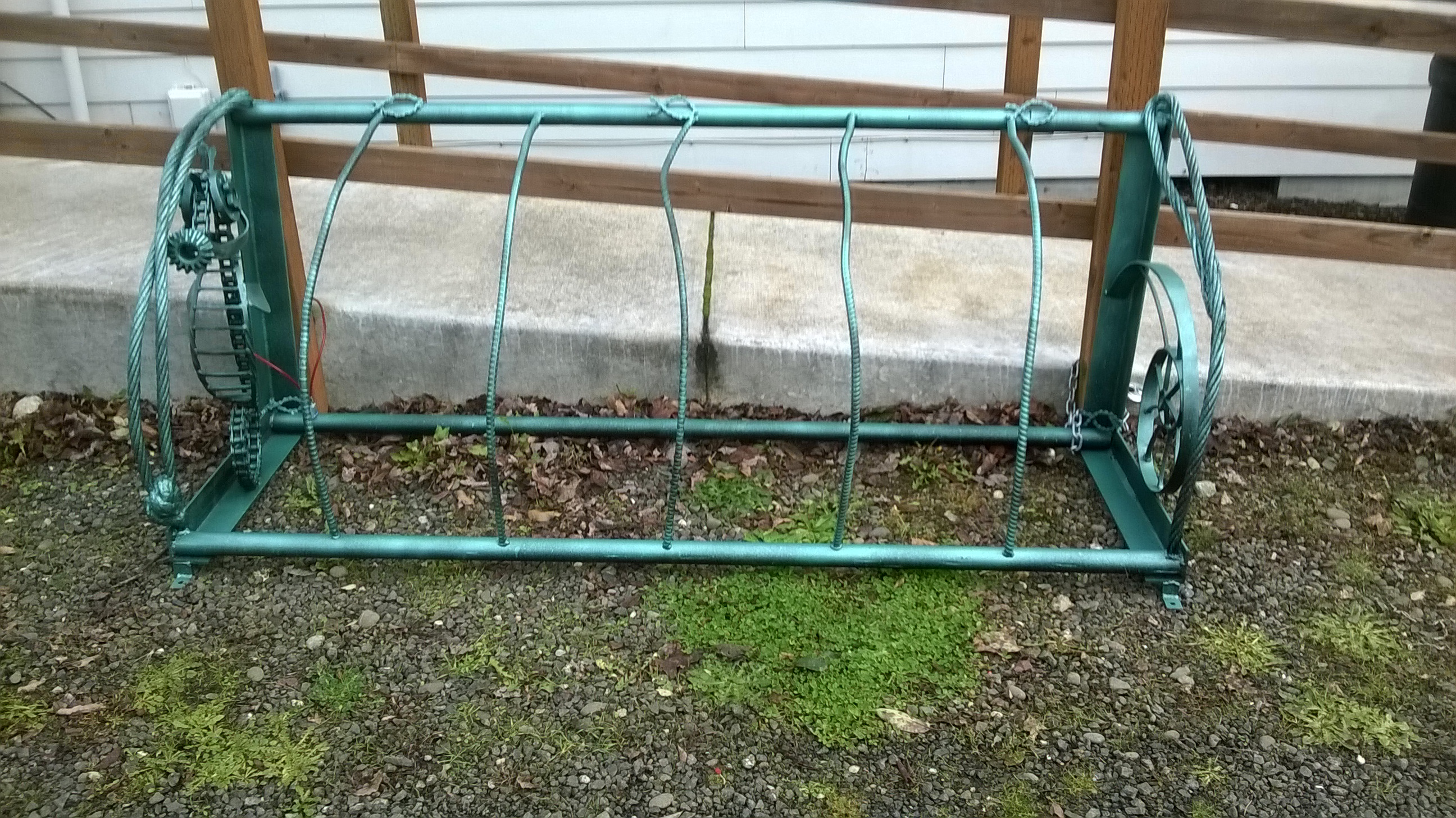
| Bike Rack added | |
 |
 |
| Added bike rack to back patio which was made from spare metal parts welded together by a local artist Becca the Bad. | |
Full slide show of our premises.
Peace
Friends’ peace testimony arises from the power of Christ working in people’s hearts. Since there is that of God in every person,Friends believe that every person is worthy of infinite respect. Our words and lives should testify to this belief and should stand as a positive witness in a world still torn by strife and violence. The Society of Friends has consistently held that war is contrary to the spirit of Christ and stated its position clearly in the Declaration to Charles II in 1660:
We utterly deny all outward wars and strife, and fightings with outward weapons, for any end, or under any pretense whatsoever; this is our testimony to the whole world…. The Spirit of Christ, by which we are guided, is not changeable, so as once to command us from a thing as evil, and again to move unto it; and we certainly know, and testify to the world, that the Spirit of Christ, which leads us into all truth, will never move us to fight and war against any man with outward weapons, neither for the Kingdom of Christ nor for the kingdoms of this world…. Therefore, we cannot learn war any more.
We base our peace testimony on a fundamental conviction that war is wrong in the sight of God.
So the keeper of the House of Correction was commanded to bring me up before the Commissioners and soldiers in the market place; and there … asked me if I would not take up arms for the Commonwealth against the King. But I told them I lived in the virtue of that life and power that took away the occasion of all wars, and I knew from whence all wars did rise, from the lust according to James’ doctrine (James 4:1). . . . But I told them I was come into the covenant of peace which was before wars and strifes were.
George Fox, 1651
Since our first allegiance is to the God of love, we must obey the law of God rather than human law when this allegiance is challenged by the demands of the state. We support those who oppose war by performing work as conscientious objectors and those who resist any cooperation with the military. We hold in love, but disagree with, those of our members who feel that they must enter the armed forces. We recognize that the entire military system is inconsistent with Jesus Christ’s example of love. We work toward the day when armaments and conscription will no longer be tolerated.
Since our peace testimony is not only opposition to active participation in war but a positive affirmation of the power of good to overcome evil, we must all seriously consider the implications of our employment, our investments, our payment of taxes, and ourmanner of living as they relate to violence. We must become sensitive to the covert as well as the overt violence inherent in some of our long-established social practices and institutions, and we must attempt to change those elements which violate that of God in everyone.
Our historic peace testimony must be also a living testimony as we work to give concrete expression to our ideals. We would alleviate the suffering caused by war. We would refrain from participating in all forms of violence and repression. We would make strenuous efforts to secure international agreements for the control of armaments and to remove the domination of militarism in our society. We would seek to be involved in building national and transnational institutions to deal with conflict nonviolently.
The almost unimaginable devastation that results from modern war makes ever more urgent its total elimination.
The Bible and other religious literature are the rightful heritage of us all, and study and discussion in the family are a valuable source of religious training. Yet the written word has little meaning unless it leads to the expression of personal religious experience, which is the work of the Spirit behind the word. As individuals and families we must show our children and each other that our search for truth involves every aspect of life.
In what ways does our Meeting help to develop the spiritual lives of our children and of all of our members and attenders?
Do we provide our children and young adults with a framework for active, ongoing participation in Meeting?
How do we encourage our children to participate actively in Meeting?
How do we share our deepest beliefs with our children and with one another? What influences among us tend to develop our religious life?
April 13, 2014
Port Townsend Friends Meeting is a community of 16 active members, and 10 regular attenders. On most First Days we have 15 to 20 people gathered for Meeting for Worship. Our Meetings have been rich and deep with inspired vocal ministry. We also have a midweek Meeting for Worship with a small and committed group.
We have organized Spiritual Nurture Groups as an outgrowth of our retreat in November, 2012. Four groups have each set their own agenda and frequency of meeting. Our hope is that these groups will continue to provide a place for spiritual growth and inspiration for ministry.
Meeting House Committee has continued to explore various opportunities to find a home of our own. We have looked at properties and considered sharing space with other groups.
Members of our Meeting continue to play a major part in providing planning and logistical support for the annual Canoe Journey for Native American youth. Over 250 community volunteers worked together on this program, which speaks to long-standing Friends concerns to empower Native Americans.
We are active in the greater Port Townsend community, participating along with other members of the faith community and other agencies, in the program to feed and shelter the homeless. We cooperated this year with the congregations of the local synagogue and the Buddhist community. This fall we met with St. Herman’s Eastern Orthodox Church to plan our week together in January, 2014. We provided night monitors in addition to cooking and serving the evening meal and providing an early breakfast and bagged lunches.
Our Peace and Social Concerns committee is involved locally, regionally, nationally and internationally in a number of activities and concerns. Some members participate in a weekly demonstration at the Indian Island Munitions Depot and some of us have taken part in Anti-Trident Vigils at the Bangor Naval Base. Other members are involved in Friends Committee on Washington Public Policy (including attending Quaker Lobby Day in Olympia), Washington Coalition against the Death Penalty, Friends Committee on National Legislation, American Friends Service Committee, Friends for Lesbian Gay Bisexual Transgender and Queer Concerns, Friends World Committee for Consultation, Quaker United Nations Organization and Friends General Conference.
In September, Meeting oversaw the first wedding under our care. The bride is a member of San Francisco Meeting, the groom a member of Port Townsend Meeting. The wedding was a joy to both meetings!
The Meeting approved a scholarship and organized a January 2014 yard sale raising additional money, so that we could send a member of or Meeting to Pendle Hill for the spring 2014 term. We look forward to rich spiritual rewards, to be shared upon her return.
At our annual Christmas party we enjoyed a marvelous potluck, followed by “sharing from the Spirit” which provided fellowship and insight into each other’s spiritual journeys.
In the fall we planned the Quarterly Meeting with Whidbey Island Meeting. We also celebrated with them the first anniversary of their becoming a Monthly Meeting.
Singing before Meeting has long been an integral part of our worship. Unfortunately, to the sorrow of many, singing has become sporadic in the absence of enough piano playing Friends to lead us. We appreciate the written weekly announcements online which help keep us organized.
The membership of our group has changed this year. We have lost several beloved members to moves and other meetings, and have gained several new members and attenders. We have struggled to fill our committee positions. Our Meeting is like a tree trunk, with many of the old branches missing, but with new, smaller branches thriving and taking the place of the older ones. We have been growing spiritually in this time of transition.
Friends’ way of conducting business is of central importance to the very existence of the Meeting. It is the Quaker way of living and working together; it is the way that can create and preserve a sense of fellowship in the Meeting community. The right conduct of Business Meetings, even in matters of routine, is a vital part of the worship experience. The process of individuals submitting themselves to the corporate revelation of God’s truth forms the basis of Friends’ approach to unity.
All members are encouraged to attend Business Meetings and be faithful in the service of the Meeting’s affairs. Appointments of officers and committee members should be made with careful consideration of the qualifications of those named and of the opportunities for growth that may be afforded. Friends should not accept any service to which they are nominated without an accompanying sense of leading and a capacity for the task, nor should they lightly refuse such service.
Proceed in the peaceable spirit of the light of Truth, with forbearance and warm affection for each other.
Be willing to wait upon God as long as may be necessary for the emergence of a decision which clearly recommends itself as the right one.
Feel free to express views, but refrain from pressing them unduly.
Guard against contentiousness, obstinacy and love of power. Admit the possibility of being in error.
In Meetings for Business, and in all duties connected with them, seek the leadings of the Light.
Are our Meetings for Business held in the spirit of a Meeting for Worship in which we seek divine guidance for our actions in love and mutual forbearance?
How well do our Meetings for Business lead to a corporate search for and revelation of God’s truth?
How effectively do members of the Meeting participate in the tempering and strengthening of the leading of individuals?
As difficult problems arise, are we careful to meet them in a spirit of love and humility with minds open for creative solutions? Do we avoid pressure of time, neither unnecessarily prolonging or unduly curtailing full discussion?
Are we aware that we speak through inaction as well as action?
Are we prepared to let go of our individual desires and let the Holy Spirit lead us to unity?
Do we recognize that the search for unity may require us to accept with good grace a decision of the Meeting with which we are not entirely in agreement?
In what ways do we each take our share of responsibility in the service of the Meeting?
Are younger Friends, new members, and attenders given appropriate responsibility in the Meeting?
John Woolman’s simple statement in A Word of Remembrance and Caution to the Rich (1793) may serve as a beginning for all consideration of stewardship: “As Christians, all we possess is the gift of God, and in the distribution of it we act as his stewards; it becomes us therefore to act agreeably to that divine wisdom which he graciously gives to his servants.”The principle of stewardship thus applies to all that we have and are, as individuals, as members of groups, and as inhabitants of the earth. As individuals, we are obliged to use our time, our various abilities, our strength, our money, our material possessions, and other resources in a spirit of love, aware that we hold these gifts in trust, and are responsible to use them in the Light. As Friends, and as members of other groups, we seek to apply the same spirit to the use and contribution of our corporate resources. As people, we are obliged to cherish the earth and to protect all its resources in a spirit of humble stewardship, committed to the right sharing of these resources among people everywhere.
“To turn all we possess into the channel of universal love becomes the business of our lives”–this, in the words of Woolman, is the meaning of Quaker stewardship.
Do we regard our time, talents, energy, money, material possessions, and other resources as gifts from God, to be held in trust and shared according to the Light we are given? How do we express this conviction?
What are we doing as individuals and as a Meeting to use and thereby perfect our gifts? How do we encourage others to use theirs?
How do we exercise our respect for the balance of nature? Are we careful to avoid poisoning the land, air, and sea and to use the world’s resources with care and consideration for future generations and with respect for all life?
In what other ways do we carry out our commitment to stewardship?